TruGem

Better Hiring Decisions by Design

For the person accountable for the call

Hiring Decisions You Can Defend

TruGem gives your hiring panel a structured, honest way to evaluate candidates and a defensible record of how the call was made. Same people. Same judgment. Made comparable, less biased, and on the record.

A 30-minute walkthrough on a real role. No commitment.

Founding-partner accounts are still available: 10 spots remain.

What it costs when it goes wrong

½ to 2×

The cost of a bad hire on a critical role. Source: SHRM.

For a plant manager around $130K, that is roughly $65K to $260K per bad hire. Six figures even at the low end, before you count the production hit.

The quieter cost: a decision you cannot reconstruct

When a hiring decision cannot be shown later, a routine question becomes a credibility or compliance problem. Not because the call was wrong, but because the record was never there to show how it was made.

Why good people still get it wrong

It is not a people problem. The process is built to fail in three specific ways.

The loudest voice wins

Honest disagreement gets overridden by whoever is most senior or most insistent.

The average hides the flaw

A good-looking overall score is exactly how a fatal weakness stays invisible.

There is no record of why

When the decision is questioned, there is nothing that shows how the call was actually made.

Fix these three, and you have fixed hiring. That is all TruGem does.

The shift

From
To
Gut feel
Honest, independent evidence
Politics and seniority
Structured, comparable scoring
The loudest voice in the room
A permanent record of the decision

Same people. Same judgment. Made honest, comparable, and on the record.

The defensible record your other systems do not give you

Your ATS tracks where a candidate sits in the process. It does not show whether your panel actually agreed, or why you chose. TruGem produces the one thing that does.

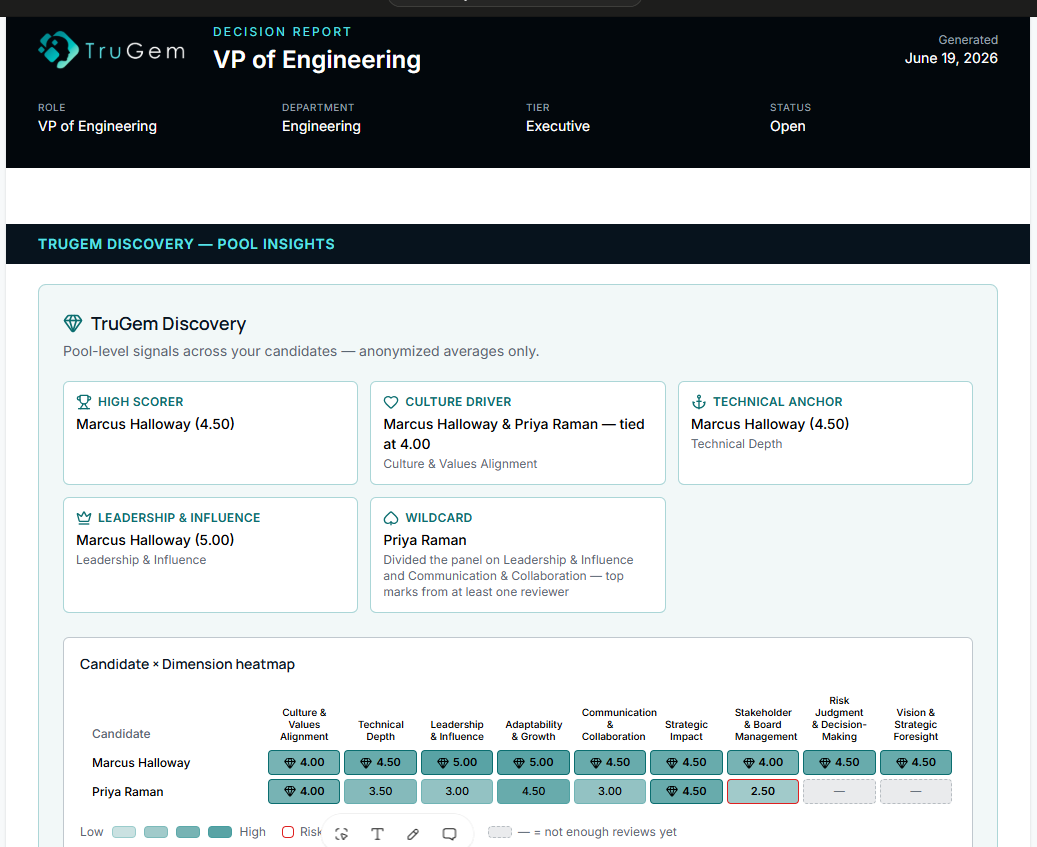
TruGem Decision Report
The TruGem Decision Report

Clean, shareable, permanent

Who was evaluated, on what, where the panel agreed and disagreed, and the call you made.

Ready before the offer goes out

On file from the moment you decide. Not reconstructed months later from memory.

Your answer when anyone asks how and why

Leadership, legal, or yourself a year from now. This preserves the decision process.

“When anyone asks how you chose, this is your answer.”

How it works

Five steps, built to kill the three failures above.

  1. 1

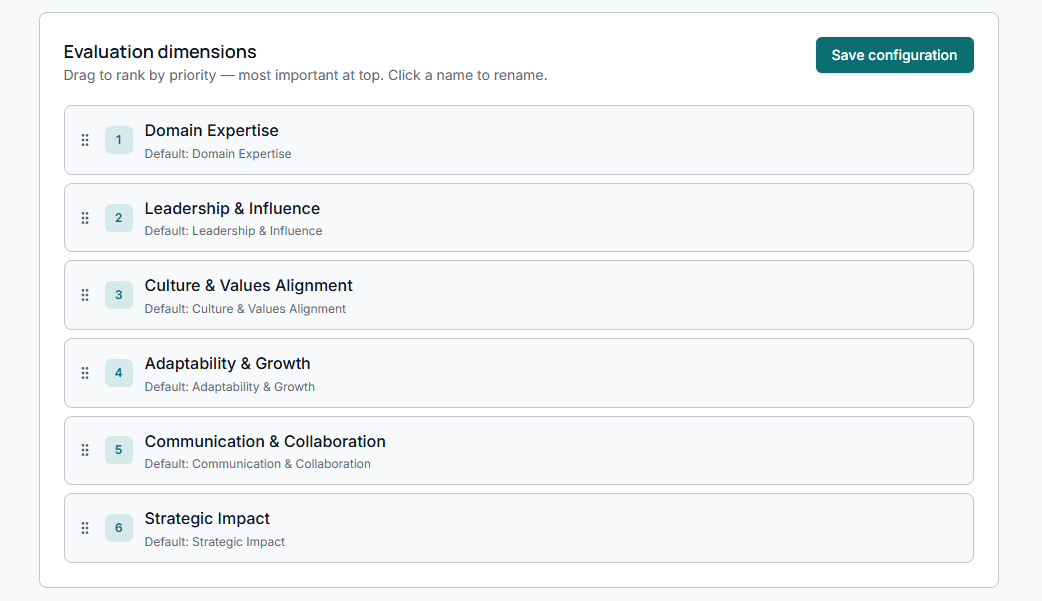
    Set up the decision

    Rank what matters for the role. Everyone evaluates against the same priorities, so you are comparing like for like.

  2. 2

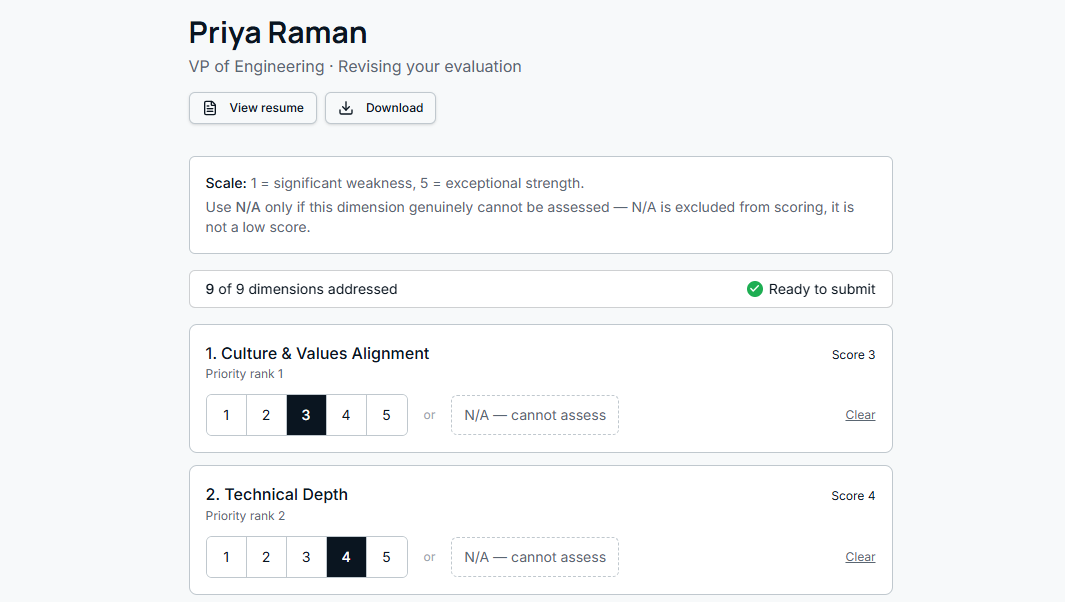
    Score independently

    Reviewers score on their own. Scores pool anonymously, which removes the loudest-voice problem at the source.

  3. 3

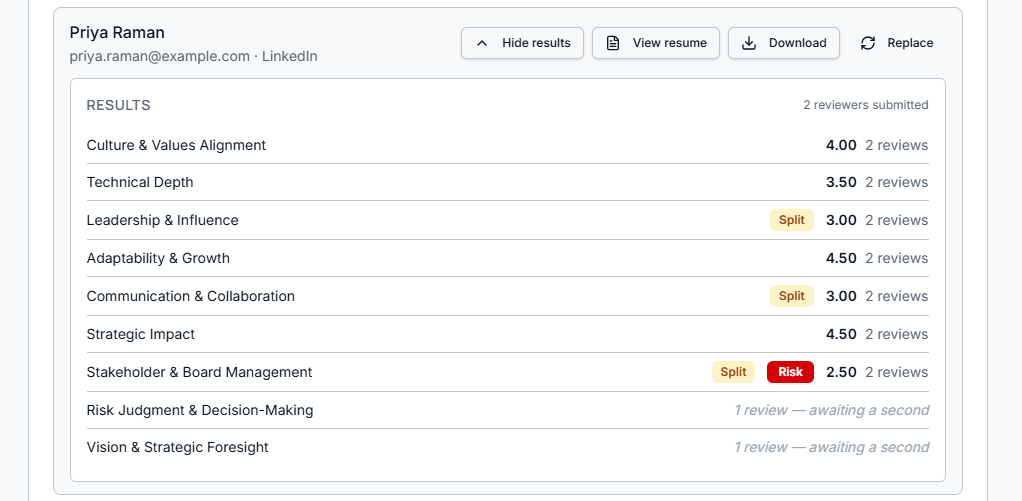
    Surface the Split Signal

    Split Signal

    Where the panel sharply disagreed, surfaced instead of smoothed over. You talk about it before the offer goes out, not after the hire fails.

  4. 4

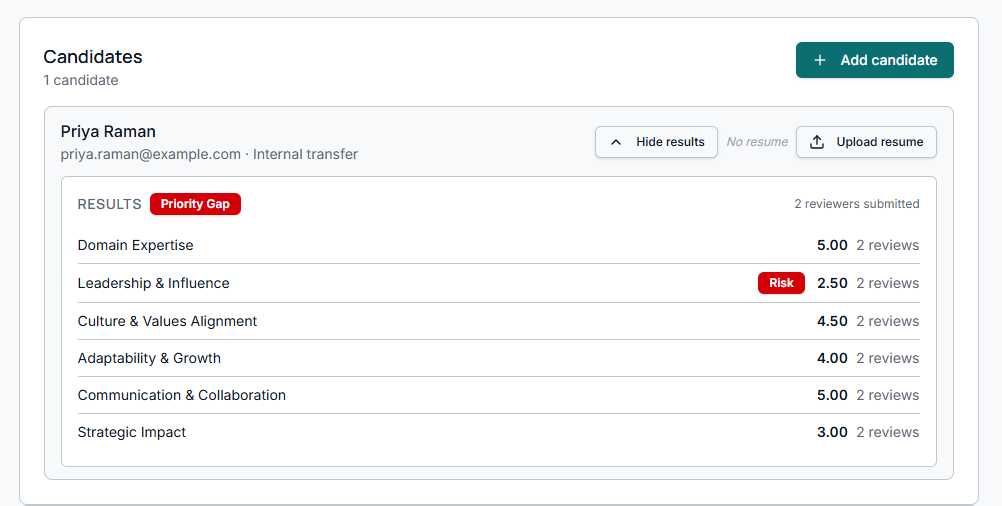
    Catch the Risk Flag

    Risk

    The real weakness hiding behind a strong average. Here, the average cannot bury it.

  5. 5

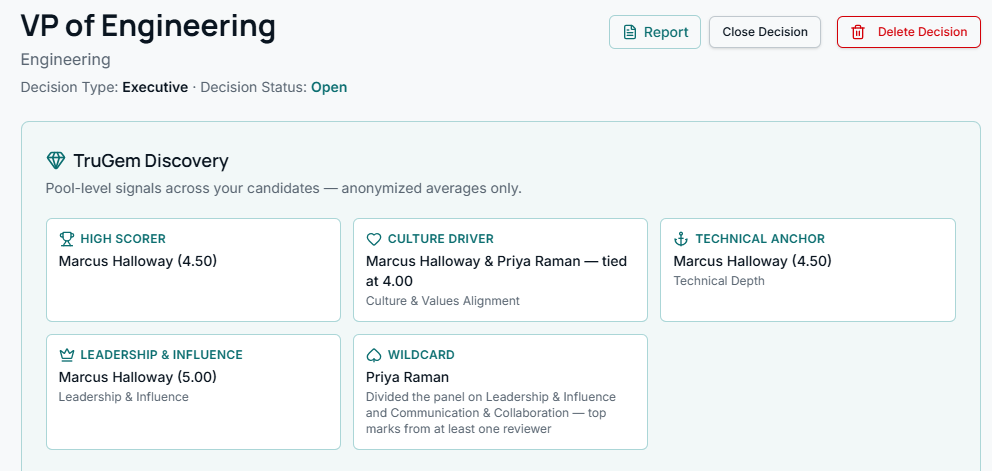
    Find the wildcard

    The strong, non-obvious candidate a normal process screens out, surfaced so you actually look.

Christian Torres, founder of Stark Analytics

Why I built TruGem

I'm Christian Torres, founder of Stark Analytics, a decision intelligence advisory firm that specializes in building the execution layer between data and human decision-making.

Hiring is the highest-stakes decision most teams make with the least structure. I built TruGem because I needed the tool myself. A way to make a panel's judgment honest, comparable, and on the record, so the call still stands up a year later.

That's the whole product. No black box. No algorithm deciding for you. Your people's judgment, given the structure it deserves.

Learn more about the thinking behind TruGem at Stark Analytics.

Why you can trust what it tells you

Humans decide, not an algorithm

TruGem does not score with AI or predict your hire. Your people make the call. TruGem makes their judgment honest and legible.

A consistent, documented process

The same structured evaluation, every time, on the record. That is exactly what defends you in an audit or a challenge.

Built to be defensible

To your CEO, your lawyer, and your IT team. Multi-tenant isolation, role-based access, and a logged audit trail are the product, not an afterthought.

We do not replace your decision. We make it defensible. That is why you can put your name on it.

Built for the shift from credentials to judgment

For a century, we hired for knowledge. The person who knew the answer, or knew where to find it, won.

That advantage is gone. AI can draft, analyze, and produce in seconds. What it cannot do is decide whether the answer is right for your business, or take responsibility when it isn't. That still belongs to a person.

So the thing that separates a strong hire is no longer what they know. It's their judgment. The 2026 research is consistent on this. As output gets cheap, judgment gets valuable.

Every TruGem evaluation scores it directly. Critical Thinking and Judgment, and the ability to keep learning as the tools change, are built into every template. Not as soft extras. As core dimensions, on every hire.

You're not just hiring for today's skills. You're hiring for the judgment to use them well. TruGem is built to evaluate exactly that.


KnowledgeJudgment
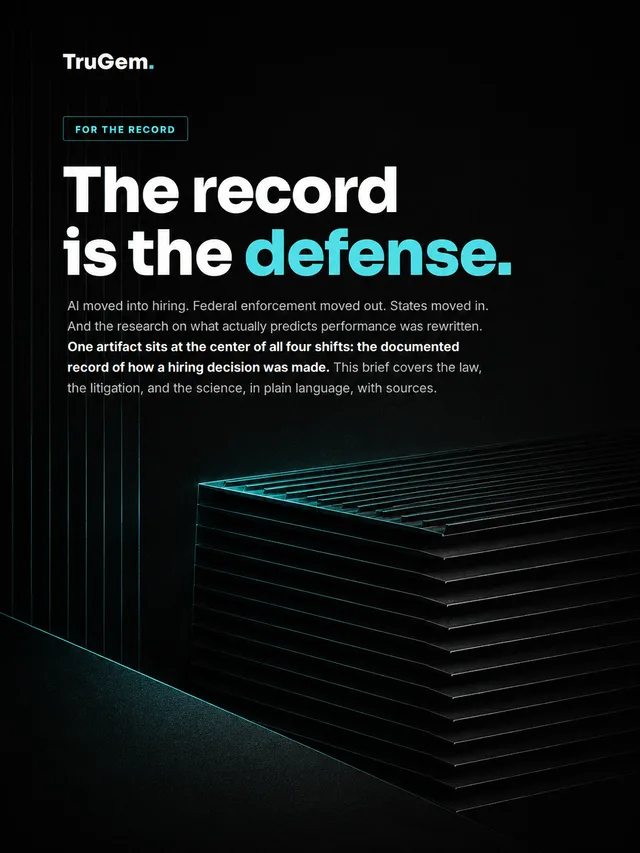
Cover of the TruGem research brief, The Record Is the Defense.
Research Brief

The Record Is the Defense

AI moved into hiring. Federal enforcement moved out. States moved in. And the research on what predicts performance was rewritten. One artifact sits at the center of all four shifts: the documented record of how a hiring decision was made. This brief covers the law, the litigation, and the science, in plain language, with sources.

Download the brief

Free. No email required.

The math

One bad hire
$0+

$150,000+ on a single critical role, conservatively, before the production hit.

vs
TruGem, all year
One flat annual price

A fraction of being wrong one single time. And you hire more than once a year.

Less than one tenth the cost of being wrong once.

At just 8 hires a year, that is $12K to bring structure to over $1.2M in hiring decisions.

Cost basis: ½ to 2× salary per bad hire. Source: SHRM.

The Defensible Hiring System

  • Unlimited hiring decisions, all year
  • A 1-hour onboarding session to get your panel scoring right from the first hire
  • An included quarterly working review of how your decisions are playing out
Flat annual price
$12,000/ year

Unlimited hires. Everything above included.

A 45-day money-back guarantee. If TruGem isn't right for you, we refund it. No conditions, no hoops.

No per-decision fees, no credits, no tiers. One flat price.

Become a founding partner

Not a contract. A working engagement on your next real hire.

1010 founding-partner spots remaining

You're one of the first partners on TruGem

Founding rate: $9,600 for the year. You get me directly, and your hires help shape where the product goes next.

Direct, personal support

You are onboarded personally and supported hands-on through your first real hire.

A quarterly working review

We check in every quarter to make sure it is working and you are getting value from it.

A 45-day money-back guarantee. If TruGem isn't right for you, we refund it. No conditions, no hoops.

FAQ

Frequently asked questions

TruGem is a hiring decision platform that helps a panel of reviewers evaluate candidates with structure, surface honest disagreement, and produce a defensible record of how the decision was made. It reduces bias and brings structure to hiring. It does not score candidates with AI or predict who will succeed.

An ATS or HRIS tracks where a candidate sits in the hiring pipeline. TruGem works on the decision itself: it makes the panel's evaluation honest and comparable, surfaces where reviewers disagree, and creates a permanent record of why a candidate was chosen. It sits alongside your existing systems rather than replacing them.

No. Humans make every decision. Reviewers score candidates themselves, and TruGem structures and aggregates that judgment honestly. It does not auto-score, parse resumes with AI, or predict outcomes.

No, and any tool that claims to is overselling. TruGem reduces bias and surfaces it for review by anonymizing individual scores, requiring independent evaluation, and flagging where the panel disagrees. It structures the human decision so bias has fewer places to hide.

TruGem is $12,000 per year for unlimited hiring decisions, with a 1-hour onboarding session and a quarterly working review included. There are no per-decision fees, credits, or tiers. A founding rate of $9,600 for the year is available to early partners.

TruGem is built for the senior HR or People leader who owns high-stakes hiring, particularly at mid-market manufacturers where a bad hire on a critical role can halt production. It is most valuable for roles you cannot afford to get wrong.

TruGem is priced against the cost of being wrong, not the number of hires you make. A single bad hire on a critical role typically costs half to two times that role's salary, often six figures. At a flat annual price for unlimited decisions, it pays for itself by preventing one.

Yes. Each company's data is isolated in its own tenant, access is role-based, and any view of individual reviewer scores is logged with a documented reason. The same controls that make a decision defensible internally make it defensible to your IT and compliance teams.

No. Reviewers score a short set of dimensions from one to five on their own time. It takes a few minutes and replaces the hour-long debrief argument that leaves nothing on file.

A founding partner gets early-access pricing of $9,600 for the year, hands-on onboarding, and direct support through their first real hire. It is a working engagement on a live role, not a long contract.

Request a demo

See it on one of your real roles

The fastest way to understand TruGem is to watch it work on a role you are actually hiring for. Thirty minutes, no commitment.